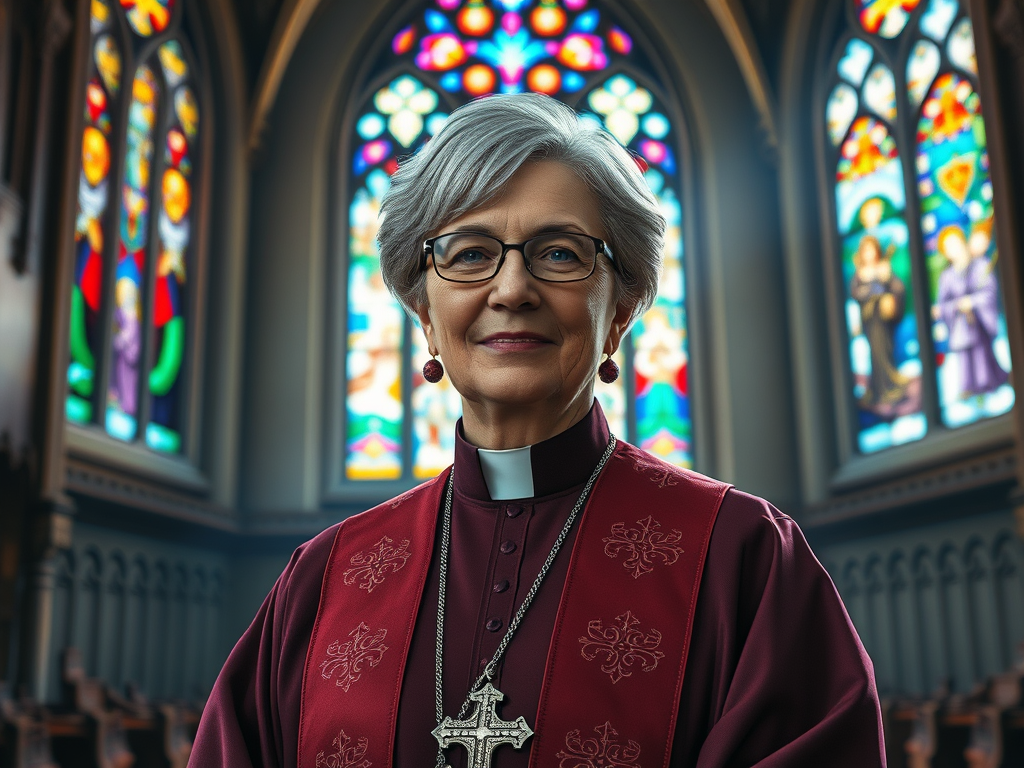
After securing a two-thirds majority of the electoral votes, Cherry Vann was appointed the archbishop of Wales on July 30th, 2025. She became the first female who is openly gay to hold this position, having served as a bishop for five years, and having been among the first women to be ordained into the priesthood in the church of England back in 1994.
One may read through this and get amazed for two very opposite reasons:
- On the one hand, the liberal or the side on the left of the political spectrum will look at this and see a lot of progress, something that the Catholic Church has been accused of not practicing for many years: no women priests as well as not opening the doors of the vocation to the priesthood to those who are openly gay. As late as early this year, there were demonstrations by some liberal women who wanted women to be involved in the conclave that elected Pope Leo XIV as the 267th Successor of St Peter. These women protested against ‘patriarchy’ and wanted women, even though there are no women priests in the Catholic Church, let alone cardinals, to be involved in the election of the pope. To this group of people, I would guess that the news from Wales must have been a huge welcome, a show of progress towards a more inclusive church. But are they right to have these demands?
- On the other hand, there are groups of people who are troubled and seriously disgusted by this appointment for many reasons. Given the need for political correctness that has prevailed in the global political space for many years now, in which everyone has been forced to be more ‘inclusive’, a case in which we are not allowed to call out anything wrong or that we disagree with to remain politically correct, this appointment seems more political than Divine. First, it meets the political expectations of the liberal left, where women have to take up leadership positions within the church, and men are not left to ‘dominate’ the religious leadership positions. Secondly, it elevates a ‘minority’ to one of the highest positions of leadership within the church of England. It begs the question: what are these lady’s doctrinal teachings that might have inspired her elevation to such a prestigious leadership position? Has she been exemplary in living the Christian virtues? I doubt, given the fact that she is publicly living in a state of mortal sin.
Pope Benedict XVI, in the encyclical Caritas in Veritate, mentioned
The Church does not have technical solutions to offer and does not claim “to interfere in any way in the politics of States.” She does, however, have a mission of truth to accomplish, in every time and circumstance, for a society that is attuned to man, to his dignity, to his vocation. Without truth, it is easy to fall into an empiricist and sceptical view of life, incapable of rising to the level of praxis because of a lack of interest in grasping the values — sometimes even the meanings — with which to judge and direct it. Fidelity to man requires fidelity to the truth, which alone is the guarantee of freedom (cf. Jn 8:32) and of the possibility of integral human development. For this reason, the Church searches for truth, proclaims it tirelessly and recognises it wherever it is manifested. This mission of truth is something that the Church can never renounce. Her social doctrine is a particular dimension of this proclamation: it is a service to the truth which sets us free. Open to the truth, from whichever branch of knowledge it comes, the Church’s social doctrine receives it, assembles into a unity the fragments in which it is often found, and mediates it within the constantly changing life-patterns of the society of peoples and nations.
The Church is not a political body. The Church is meant to lead souls to Christ, and this mission demands a lot from all the members of the Church. We are all called upon to carry our crosses daily and follow Christ(cf Mt 16:24-26). This involves renouncing sin and striving each day to become better versions of ourselves. The call to follow Christ is not a simple task since we must all aim to be Christ-like, an impossible task if we do not submit to Christ, as He clearly says that without Him, we can do nothing.
As Christians, we are also called to lead others to Christ… to evangelise and be the new apostles in this time of the history of salvation. In doing this, we must be aware that our deeds and how we live our everyday faith may bring others close to Christ, or take them far away from him, since it is by our deeds that ‘they will know that we are His disciples’.
How then does this appointment of someone who lives in a permanent state of mortal sin help in bringing others to Christ? Could this be part of the reason why more young people are converting to the Catholic Church than to the Church of England in England? As a catholic, and I guess many authentic Christians fall in this category, I need clear teaching from my priest and when I go for confession, it is most important that my sins are given by Christ through the person of the priest, and that I get guidance on how to overcome my sinful ways, than giving me false hope that there is no need to change my way of life. We are called to abandon our old ways of life and follow Christ. All of us.
Maybe it is time for the different churches to rediscover their missions. A church’s key mission is to bring people to Christ, and any institution that does not call people to repentance and to get off their sinful ways isn’t living its mission and doesn’t warrant being considered a church, but a political organisation or some charitable institution. Together with Robert Cardinal Sara, I’d say to those who want a church that does not condemn sin.
“… We mustn’t separate doctrine from pastoral practice, thereby claiming to bring healing, because one can’t bring healing in this way. … Because mercy requires repentance. If I’ve done something wrong, I repent. If I did something wrong, in order to repent, I have to break with the evil I’ve done. This is mercy. Take the prodigal son, for example. He left home in order to say, ‘I’m independent, I’m autonomous from my father. ’ The father wants to forgive him, but if the prodigal son doesn’t return home, he can’t be forgiven. To be forgiven, he has to renounce his life and return home.”
 Elly Okinyo
Leave a comment